Act, Potency, and Causality
There is an issue concerning change. If one thing changes into another, there is a concern that the prior thing ceases to be and a new thing comes to be. The Pre-Socratic philosopher Parmenides noted that insofar as nothing comes from nothing, it cannot be the fact that one thing changes into another. This is because the new thing comes from the ceasing to be of the old thing, in which case there is a gap of nothingness between the two things, from which nothing can come to be. This was an important problem in the history of philosophy. Effectively Parmenides held that change is impossible and just an illusion; really there is no change at all.
The decisive genius of Aristotle was to show that change is possible. Aristotle agreed that it is absurd to say that e.g. the non-musical becomes musical; for how could what is not musical be musical, that seems to break the law of non-contradiction. But what Aristotle argues is that it is not the non-musical that becomes musical, but that the man who is non-musical becomes musical. Accordingly, there is an underlying subject of change which is not that yet into which it changes. For change then there is required three things: (i) the subject, (ii) the privation or not yet what the subject will be and (iii) the form that it will be. So when it comes to the musical man, the man is the subject, he is not yet musical (he is deprived of the form of musicality), and he becomes musical.
Aristotle deployed this analysis of change to all of reality in general. In general, there is an underlying subject of change which Aristotle took to be prime matter, that subject subsists through change, and at one point such prime matter has a certain form but not another (it is deprived of the other form), and in the process of change it comes to take on that other form.
This analysis of change underlies Aristotle’s account of act and potency. The thing which is not yet another thing is in potency to being that other thing. In our musical example, the man who is not musical is potentially musical; and when he learns music he becomes actually musical. Potency designates a not yet but able to be state of affairs, and actuality designates a completed state of affairs. This is Aristotle’s philosophy of change.

White marble from Cararra, Italy… potent of so much beauty.
Aristotle widens out this account of change into a metaphysics of change.
Insofar as the thing in potency must have some reality to it by which it is in potency, e.g. matter, Aristotle argues that things have a principle of potency. By contrast, insofar as things are in actuality, Aristotle argues that things have a principle of actuality, e.g. the form that the matter takes.
St Thomas Aquinas adopts this metaphysics of act and potency and argues that causality can be analysed in such a way. Aquinas considers causality and holds that in a causal relationship the cause has some actuality which the effect lacks and which the cause contributes to the effect. The effect thus depends on the cause for its actuality and without the cause would not have such actuality. The causal relationship then for Aquinas is not one event following another, but the actualisation of a potency in the effect which the effect itself does not have. This analysis of causality then expands in a generalised metaphysics of existence whereby existence is the causal feature without which there is nothing, and it is this account of existence which we will explore in future posts.
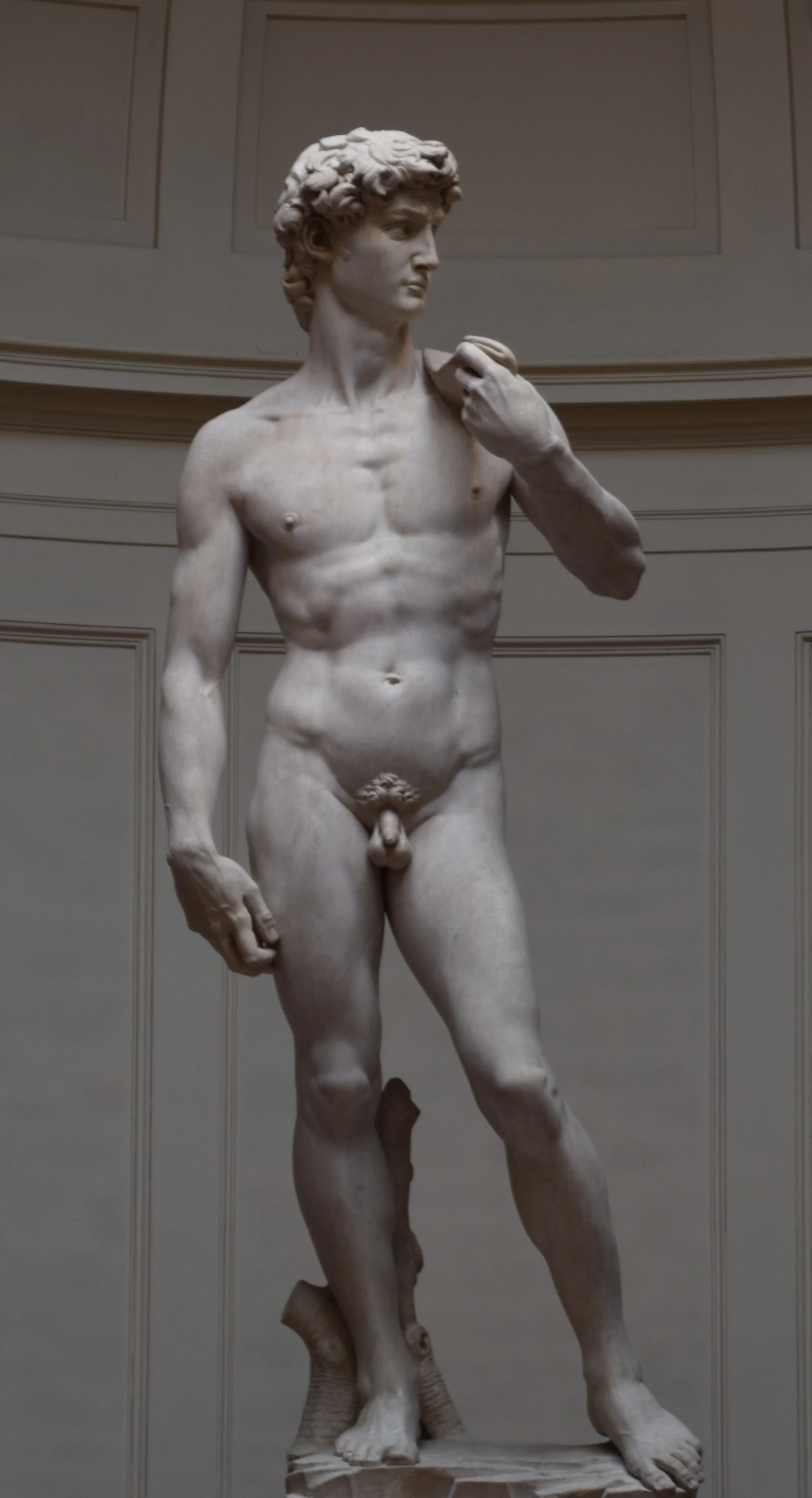
Michelangelo's David (1501–1504), carved from the white marble of Cararra.