Why be a Thomist?
Given what I have said about Thomism and Thomists in the first two posts (here and here), perhaps it is already clear why one would want to be a Thomist, or why one would happily be identified as a Thomist (even one of the ‘Strict Observance’) By taking Aquinas as a primary guide in the life of the mind, one hands oneself over to someone who is both sure in his argumentation and insightful in his conclusions, conservative in his preservation of the intellectual inheritance bequeathed to him, and liberal in his application of this tradition together with the innovations he charitably introduces.
But why even take a guide in the life of the mind? Why not just think in a totally independent way and come to your own conclusions without the help of others. Why not be a pioneering philosopher and take a fresh starting point, beginning from the ground up like so much of modern philosophy? Well, apart from the fact that much of this modern innovation has ended up calling the whole philosophical project into disrepute among the general public, we can discover the reasonableness of taking an intellectual guide in the very meaning of being human, without at all questioning the modern philosophical project, for to be human is to be both educated and educator.
How so? Well, given the factual course of human life, to be human is evidently to begin life, like all other living things, in a radically undeveloped form—initially as a mere unicellular organism—which is set on a path of development toward maturity. The human individual then comes into the world ‘not-fully-made,’ and is, technically speaking, imperfect (i.e., not complete), while also ordered toward perfection (i.e., wholly complete), which is nothing less than the full stature of humanity. On the level of the body, this unfolding happens in us according to nature, just like all the other forms of animal, through adequate nutrition and appropriate bodily exercise. But on the level of the spirit, this unfolding demands our own free cooperation, as the primary protagonist of our lives, together with the mediation of others, those who help form us in the life of the spirit: intellect, heart, and will.
In this way, via the life of the mind, we are bound together with others—first as educated, later as educator—so that each of us are links of a vast chain spanning the whole expanse of human culture spread through place and time. To be a spirit, then, is to be essentially interwoven with the lives of others, where others guide us as we unfold toward human maturity, and where we then return this gift by guiding others when we have reached greater maturity. Each of us is then the recipient of a great heritage that we receive from the cultures in which we live; each of us are the beneficiaries of a great wealth, the wisdom of our ancestors, which has been wrought in the depths of humanity as history unfolded.
At the center of this cultural inheritance is the philosophical, theological, and legislative truth of the Western tradition—the philosophy of Greece, the faith of Jerusalem, and the law of Rome. This is what constitutes our primary inheritance, and it is a wealth far greater than any economic, industrial, or capital wealth we inherit from the societies into which we have been born and from which we receive the stable and comfortable lives we live. Then, at the center of this sapiential inheritance is the philosophia perennis, the philosophy of the West that had its humble beginnings in the Presocratics of Ancient Greece, which joined the theological and the legislative dimensions of culture as history unfolded, and which now unites our societies (inasmuch as they are united!) by furnishing us with a coordinate worldview and—most importantly—a shared vision of the common good.
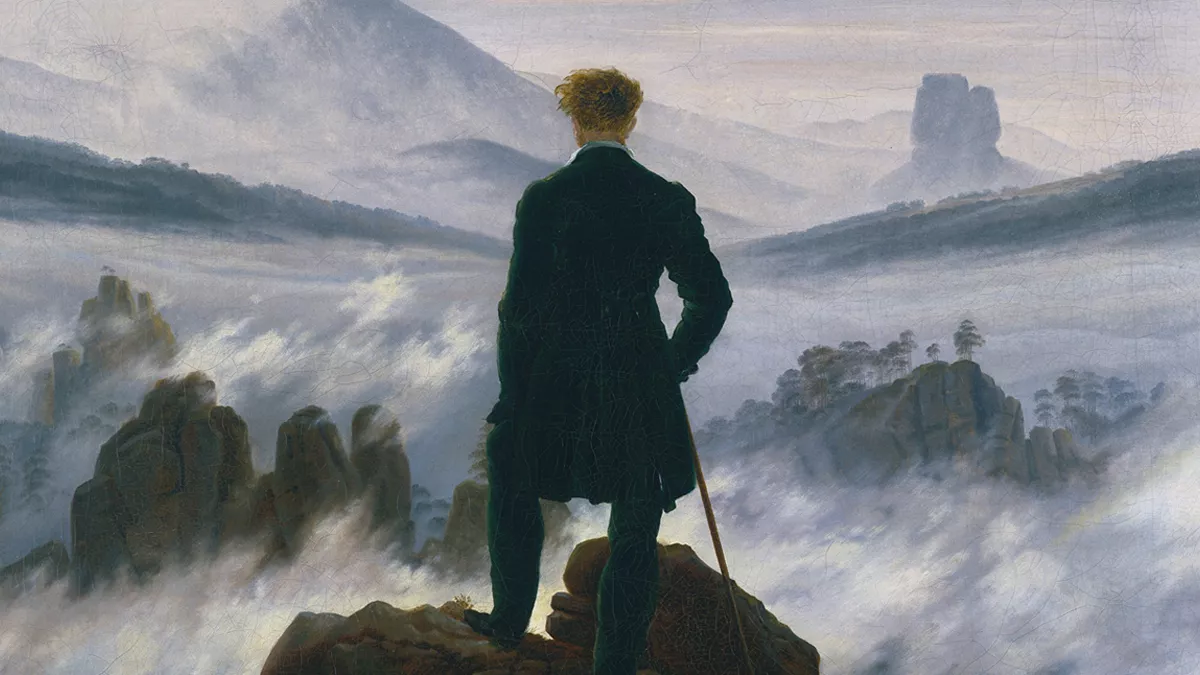
Now, if this is the case, it is entirely reasonable to assume the patronage of some or other thinker in the life of the mind, and allow oneself to be guided by this other in the venture of striving for ‘wisdom’—for it is this very assumption that makes it possible for us to enter into the wide stream of the philosophia perennis and (in the paraphrased words of Newton) stand on the shoulders of giants. Such an elevated vantage point is simply not possible to attain as isolated individuals; rather, we must seek assistance from others, and we must take that assistance and make it our own before we can contribute our part—small as that may be. And just so we can see that our journey toward wisdom is essentially communal, in such a way that we would be wise to take an intellectual great as our trusted guide in the life of the mind.
If so, why not Aquinas? Though not the only figure that commends himself to our consideration as such a guide—we could think here also of Plato and Aristotle, Boethius and Augustine, Bonaventure and Scotus—Aquinas evidently stands tall among his venerable peers, both because of his particular philosophical genius, as a thinker gifted with incisive clarity, and because of the providential moment in history at which he lived, a period in which it was still possible to synthesize the expanse of extant human learning. And this is not at all to mention the comprehensive depth that we discover in his writings once we enter into his thought world. Yet should we assume Aquinas as guide in the life of the mind, we ought not to receive his guidance in a purely passive and blindly compliant way, but rather with vigorous active engagement, by way of understanding united to true seeing. In a word, we must take what we receive to ourselves in a properly personal way.
With this last point we see that assuming Aquinas as a patron does not at all mean becoming a ‘parrot’ of his positions, summarily repeating what Aquinas (and Thomists) wrote about each given topic without attaining any genuine depth of understanding. To be a Thomist is not, as is sometimes accused, to hand oneself over to Aquinas in such a way that all our thinking is done by him—where everything comes packaged with a bow on top, so to speak—but rather in such a way that one remains an independent thinker who takes full responsibility for his or her own thought. Thomists learn deeply from Aquinas, and also from one another, yes, but always in such a way that they make this thought their own.
Admittedly, we Thomists sometimes do ourselves no favors by exposing ourselves to the critique of mimicry when our first response to any given question begins with, ‘Well, St. Thomas says…,’ should we scratch the surface, we see that this is not what it means to practice Thomistic philosophy with authenticity. Genuine Thomists don’t take Aquinas’ to themselves in such a way that they think he has answered all philosophical questions, and done so infallibly. Rather, to be a Thomist is to think through Aquinas’ prior reflections on any given topic, so that one comes to understand what Aquinas is getting at, while also coming to see that it is actually the case (or not). If one does this, as many of us have experienced, one discovers that Aquinas casts a bright light over many areas of life and reality that previously lay in darkness and obscurity.
And that is to say one experiences for themselves Aquinas’ trustworthy guidance.
Therefore, to summarize, I believe that to be a Thomist is: 1) to follow the mind of Aquinas toward truth with fidelity and conviction; 2) to track the methodology of Aquinas in his prudential selection of fitting means toward the attainment of truth; 3) to understand the ensuing concepts unearthed and crafted, together with their conceptual interconnections; and 4) to be able to share all this with others within the great collective effort of the philosophia perennis as it expands through time. In a word, then, to be a Thomist is to make Aquinas’ thought one’s own: you have to suffer Aquinas thought for yourself, and in this way earn it as your own… and that is ultimately to see its truth. Yet, one must also then be prepared, as indicated in a previous post, to come to different conclusions than Aquinas if—after careful consideration—the truth of the matter reveals that it merits such a move… for in doing so one is faithfully following Aquinas’ own allegiance to truth, while to do otherwise would be tantamount to abandoning oneself—for that is precisely what happens when one abandons truth.
